
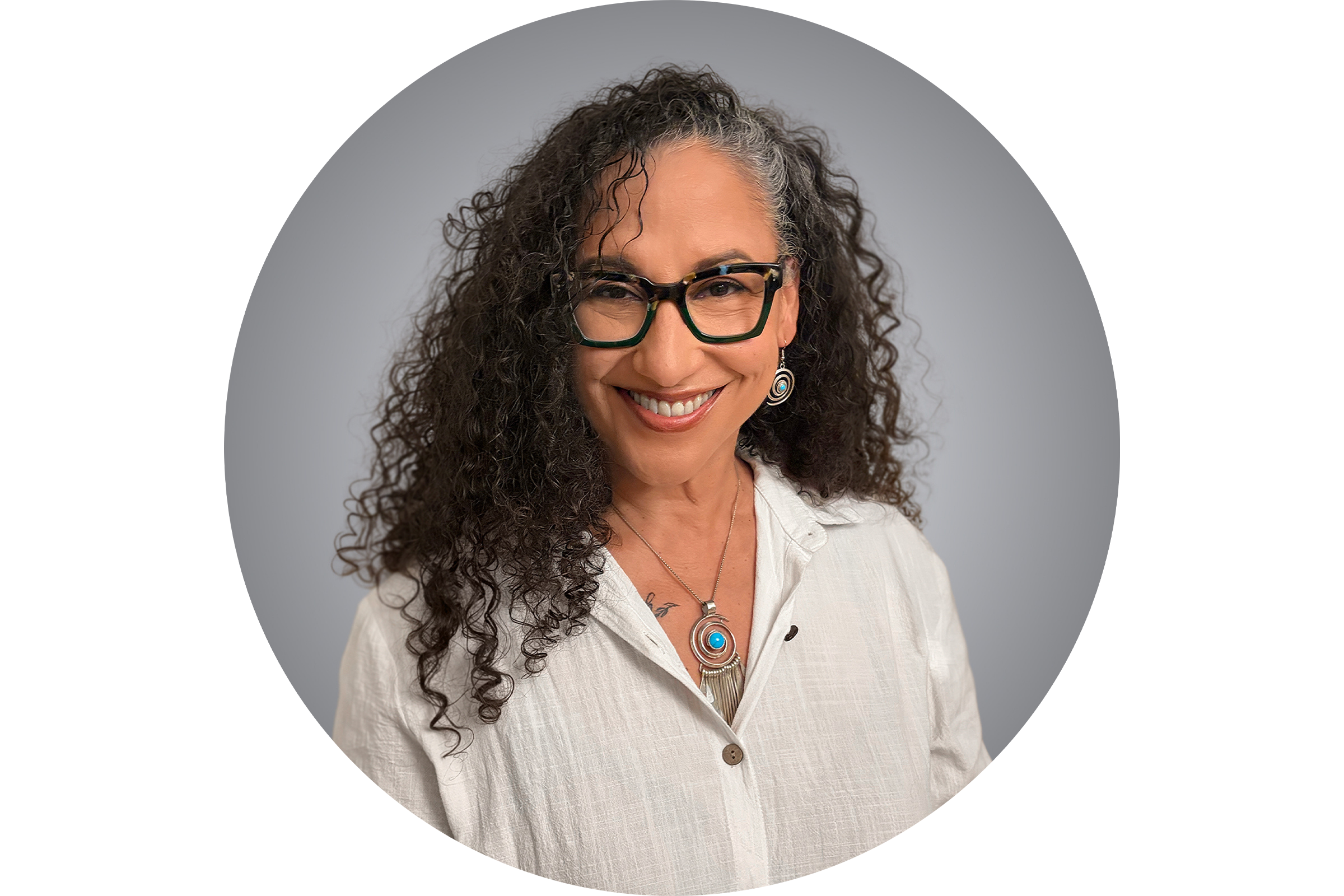
our founder

I bring an embodied understanding of how binaries operate within the American cultural landscape and shape our collective consciousness. I am a Gen X, biracial, Black, bi-coastal, pansexual, queer, neurospicy, cisgender woman and single parent, with familial roots in the Northeast and the South. I have the lived experience of disparate worlds: of being with and moving between; of belonging and not belonging; of honoring difference and acknowledging our connective tissue. My journey cultivated a deep appreciation for holding complexity and nuance within empathy and accountability; for the transformative possibilities that emerge through integration rather than polarization.
Spirituality is integral to my personal and professional life. Ongoing study and practice inform my clinical work, teaching, mentoring, and organizational development efforts, offering a framework for meaning-making, connection, and embodied presence. Over time, I realized that I no longer wanted to live or work in separate parts—to be a therapist in one space, an educator in another, an organizational consultant elsewhere, and a spiritual seeker in private. Resonant Source Therapy, Training and Consulting grew from a desire to bring these dimensions into conversation; to inhabit all facets of my work with greater wholeness and authenticity, and to support others in doing the same.
I support individuals and systems in moving beyond “either/or” thinking toward ways of being that honor complexity, relationality, and deeply held values. Across psychotherapy, graduate-level teaching, support for associate clinicians, and organizational consulting, I guide others in discerning their paths and discover what becomes possible when they bring more of themselves into the room.
taunya black (SHE/HER)
M.A., LMFT #156175
Founder of Resonant Source Therapy, Training and Consulting
Resonant Source THERAPY, TRAINING aND CONSULTING
I founded Resonant Source to create a space where healing could be held with depth, integrity, and respect for the whole person. Our eclectic group of therapists brings diverse identities and clinical orientations, allowing them to meet clients in their lived experiences and address a range of clinical concerns. Our associateship program gives associates the agency to shape who they want to become as clinicians, with the support of community and structure of a traditional organization. Our workforce development training helps organizations build healthier teams, stronger communication, and environments where people feel respected and supported.
My Path as a Therapist
We believe that mental health, physical health, spiritual health, and emotional health are inextricably linked, so our practice includes wellness collaborators who provide supplementary or standalone therapies.
Working hand-in-hand with our team of talk therapists, we can develop a comprehensive treatment plan that addresses all of your wellness needs.
To learn more about my clinical work, visit my personal website.
Organizational Development and Workplace Wellbeing
Learning to See the Whole System
Before becoming a therapist, I spent many years in nonprofit and education leadership developing policies, strengthening programs, and supporting organizations through growth, uncertainty, and transition.
Across workplace culture, policy, practice, program development, and fiscal responsibility, I discovered that organizational problem-solving is one of my strengths. Organizational challenges are rarely solved through strategy alone. Workplace culture—the relationships, values, and patterns shaping how people experience an organization—is central to its long-term health. When people feel connected to their workplace beyond a job description, they are better able to contribute, collaborate, and remain invested in the organization’s success.
My work required me to see organizations as interconnected systems. Serving as an executive leader, staff member, and board member taught me to bridge between groups with different responsibilities, perspectives, and levels of power. I have helped leaders understand an organization’s broader direction while remaining attentive to how decisions affect the people carrying out its work, supporting more sustainable relationships and organizations.
Momentum Collaborative
In 2018, I co-founded Momentum Collaborative, an organizational development consultancy focused on diversity, equity, and inclusion. I assembled a team with experience in psychotherapy, facilitation, education, and strategic management and leadership development. This range of perspectives allowed us to approach organizational challenges through both human and structural dimensions. We considered our clients’ policies and practices alongside their emotional dynamics, relationships, and behavioral patterns to assess how meaningful change could take root.
The events of 2020 brought a sudden, intense demand for DEI consulting. Momentum rose to meet that moment, working with cultural institutions, creative agencies, fintech firms, and nonprofits of all sizes and missions. We asked organizations to make a substantial commitment to the process. Executive leaders were expected to participate fully, and our engagements typically lasted 12 months, allowing us to evaluate the organization, recommend changes, and remain present through implementation.
The Psychology of Organizational Change
Burnout spread in the DEI field as the collective understanding of DEI became distorted and attacks on DEI initiatives forced many to leave the field entirely. For Momentum, these changes gave me a moment to pause and reflect on the impact I hoped to have and the ethos I wanted in my working relationships. DEI had never been a trend or a set of performative commitments for me. It was a vision of a more humane way of working and being together.
At the time, I was also working as an associate clinician. Moving between these roles deepened my understanding of Industrial-Organizational Psychology—the psychological dimensions of organizational change. My experience has shown me that workforce wellbeing is inseparable from organizational sustainability. When people are respected, supported, and able to participate fully, organizations are better positioned to retain staff, navigate conflict, adapt to change, and remain financially viable. Attending to the human dimensions of work strengthens both the people within an organization and the organization itself.
Bringing the Work into Resonant Source
Resonant Source was born, in part, from this body of work. Across psychotherapy, clinical training, and organizational consulting, our priority is to engage people as full human beings—not as diagnoses, job titles, productivity metrics, or functions within a system. We support individuals to process their experiences, develop stronger emotional and interpersonal skills, and navigate life with greater awareness and purpose. We help organizations bring their stated values into closer alignment with their practices, relationships, and decisions.
To learn more about my educational and professional background, visit my LinkedIn profile.